Name:
Email Address:
Handphone
Pertanyaan Mengenai Pakej Perkahwinan
Mekup
Jurugambar
Pelamin/ mini pelamin
Hantaran
Gift
Kad Kawin
Bunting
Printing Album Kawin
DVD cover
Lokasi Majlis
Tarikh Majlis
Ada apa-apa nak tanya..silakan :-)

This HTML form was created by Freedback.
Showing posts with label CAMERA DAN AKU. Show all posts

Wednesday, 18 April 2012

NIKON LOVERS: DO-IT-ALL-LENSES


Do-Everything Lenses
For day-to-day use, I prefer the 50mm f/1.8 for my 35mm and FX cameras, and either that or the 35mm f/1.8 DX lens for my DX cameras. I move a few steps to frame my photo, and VoilĂ , perfect pictures. I carry these small lenses when I'm spending more time carrying my camera than using it.
For people who want to carry just one lens, and don't mind the extra weight, slower speed and much higher cost, the lenses I often use when I'm out on a serious photo trips are:
Nikn 18-200mm VR II
Nikon 18-200mm VR II DX (72mm filters, 19.9oz/565g, about $850).

For DX cameras, Nikon's 18-200mm VR II has been the top do-it-all lens since it came out in 2005. Except for low-light action or crazy-wide angles, the 18-200mm does everything I need in DX. It covers every reasonable focal length, has vibration-reduction so you can forget the tripod, and you can get instant manual-focus override just by flipping the focus ring.Today's -II version is the same as the original, with a zoom lock at 18mm I never use anyway.

Nikn 28-300mm VR
Nikon 28-300mm VR (77mm filters, 28.1 oz./796g, about $940).
For FX and 35mm cameras, Nikon's 28-300mm VR does everything except for action in low-light or crazy-wide angles. The 28-300 also covers every reasonable focal length, has vibration-reduction so you can forget the tripod, and you can get instant manual-focus override just by flipping the focus ring. It is about 25% bigger in every dimension from the 18-200mm; I'm showing them at the same size for detail. With the 28-300mm VR, I can dump all my other lenses into the lake; the 28-300 is perfect for 99% of what I do on serious photo outings. The tiny 50mm f/1.8 is what I prefer to carry day-to-day, and the 28-300 is the ticket for serious all-day shooting.

NIKON LOVERS: COST VS SATISFACTION


Best Serious Cameras (DSLRs)

DSLRs, Digital Single-Lens-Reflex cameras, are the best camera for shooting action and motion. For news, sports and action, it's always an SLR.
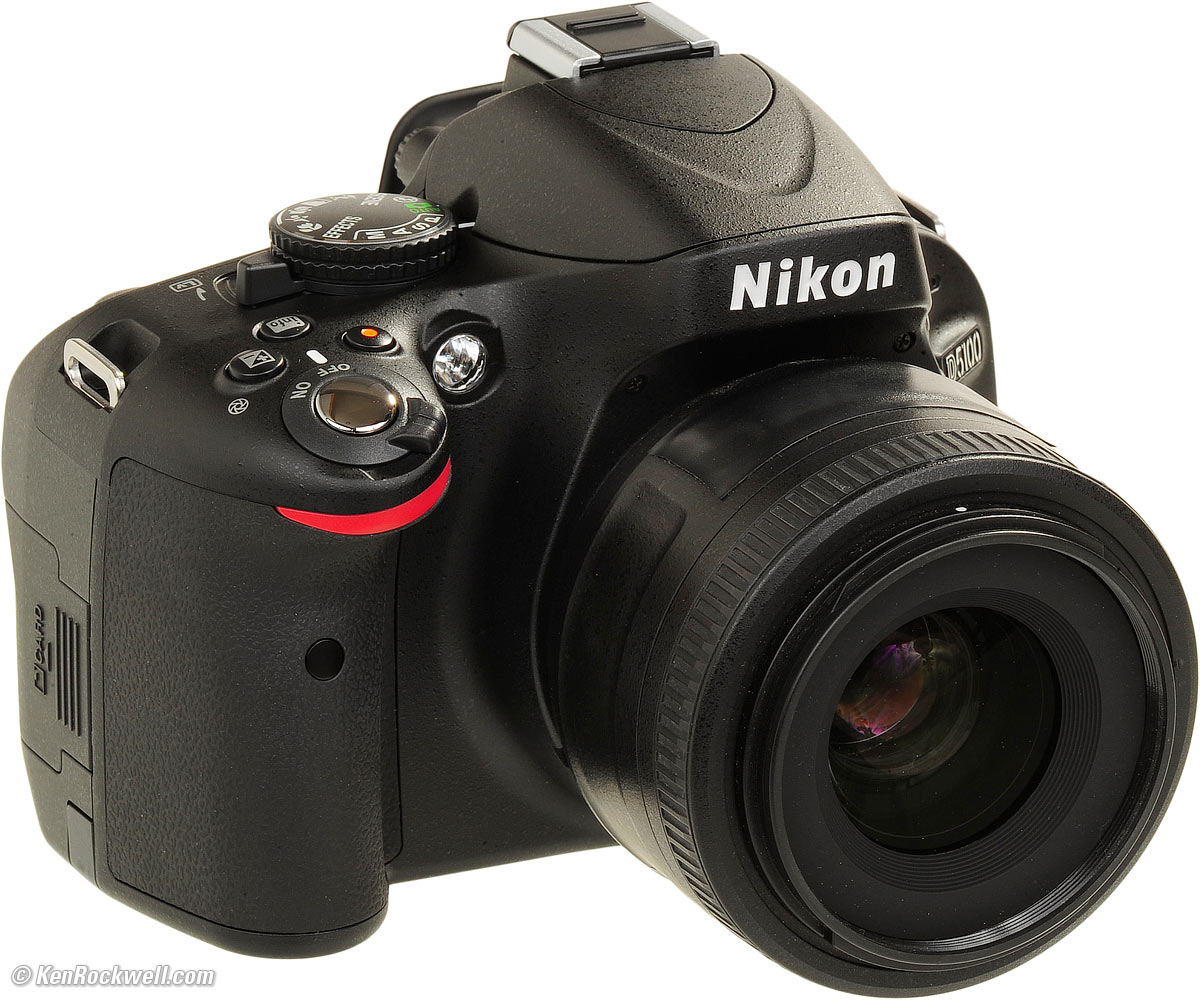
Nikon D5100
The Nikon D5100 ($849 with lens) is the best all-around camera for most people. It's an extraordinary camera, and easy to use.
If $200 matters, then I doubt that any normal person would not love the excellent Nikon D3100 ($649 with lens). If you don't want to pay more than $649, the D3100 does things about which photographers could only dream at any price just a few years ago.
Nikon D3100
The Nikon D3100 and included 18-55mm VR, the answer to most people's camera questions.

If you're the sort of person who's an accomplished photographer and reads this site everyday, then you'll appreciate the many extra features of the Nikon D7000 ($1,299 without lens). Then again, if that was you, you wouldn't be reading this page.
The new Nikon D7000 is much better than anything else, but costs as much as two D3100s. If money matters, just get the D3100. You'll love it. If you can afford the price and extra weight of the D5100 or D7000, you'll love them even more. See Is It Worth It, which says that if you have the money, sure, go for the D5100 or D7000, but if you don't, then don't worry and you'll LOVE the D3100. The biggest differences among these cameras is not technical picture quality (the pictures from these three cameras are indistinguishable from each other), but how many knobs and buttons they have to allowskilled and experienced photographers to adjust the things that most people don't even understand. A more expensive camera does not take better pictures!

Nikon D7000
The Nikon D7000 and optional 35mm f/1.8 DX, which I usually use myself, is even better, but twice as expensive.
If you have the money, then the benefit of the D7000 is that it does everything just a little bit better. It is more pleasant to use because it has a bigger, brighter viewfinder, and everything works a little faster and more smoothly. The D7000 has an LCD screen about twice as sharp as the same-sized screen on the D3100, and so it goes.
Yes, the D7000 has slightly better ability to shoot in low-light without flash, but again, few people actually do this.
The pictures will be the same. The difference between the D7000 and D3100 is mostly in how pleasant it is to hold, to own, to use and to shoot.
If you count every pixel or are a serious photographer, of course you'll appreciate many other things about the D7000, as well as probably look too close at the pictures and see some slight differences in its low-light or resolution abilities, but stand back and look at the pictures as normal people do, and they all look the same.
If you'd rather pay half as much and get the D3100, you'll love it. The pictures are the same, and the D3100 weighs less. The D3100's price includes a great lens, while the D7000 is sold without a lens so you can get exactly what you want. I cover lenses later.
I cover the much larger Nikon D700 and other DSLRs under more costly cameras. These are for special purposes; the D7000 is the best you can get overall, and the D3100 is no slouch either

Wednesday, 22 February 2012

LIGHTING CANVAS


Salam semua,
baru-baru nie aku ada pinjam majalah kawan terbaca plak pasal lighting photography perhhhh...sila la yek menjamu mata...NANTIKAN project terbaru aku hahahha konon la kan light painting mcm depa buat kat entry bawah nie..KREDIT to http://www.dslr.com


Portrait oh Portrait


tiba-tiba jer kan aku ada mood yang bermotivasi tinggi untuk membuat beberapa entry dalam  masa 4 menit hahhah...bosan menunduk ikat reben KAT BOX GIFT for my customer weeding next week maka kita rehat jup layan blog...boleh di guna pakai teknik-teknik berikut unutk project akan DATANGGGG...cik and encik-encik kucing semua tolong bersopan jangan di usik kotak-kotak tu yerrr nanti walid babab baru tauuu 

16 Inspirational Portrait Photography Techniques
Want more great projects, amazing photos, Photoshop tips, and articles on photography? Subscribe to Epic Edits today so you don’t miss a thing.


1. PHOTOSHOP

If you’re good with post-processing and manipulations, use it to your advantage. Get crazy with the adjustments, try some new Photoshop techniques, and maybe even a composite image.
147 of 365 - just dandy

2. TEXTURE

If texture is a big part of your subject, make it stand out and make it obvious. Match up the textures between your subject and your background. You might even try texturizing the entire photo for additional impact.
Beautiful old lady from Darap(Sikkim) village

3. OVEREXPOSE

Blowing out the highlights or making a high-key image makes a nice soft portrait with kind of a light airy feeling. Another advantage of high-key photos is that the smaller details and defects are blown away, making the image look much smoother.
Fly

4. UNDEREXPOSE

A dominantly dark or low-key image will naturally draw your eyes to the lighter parts. These tend to have a grittier and harder look to them than the high-key images.
Era nata racchiusa in un raggio di sole

5. BACK-LIGHT

Hair lights up like crazy when it’s back-lit, so if hair is a big part of your subject make it stand out by placing your subject between you and a light source. You could also take this a little further and push the image to a silhouette.
In her own place

6. POSING

Get crazy with the pose and positioning — extra points if it looks uncomfortable. Not only with the poses, but also with your own positioning — shoot from different angles to achieve different impacts.
The Awful Truth, Day 4: Could Be Working Harder

7. CULTURE

Capture the local culture — what’s mundane to you is exotic to us. Culture is everywhere, even in your own town. Just image you’re visiting from a different country — what things would then seem more interesting to you?
My friend Babu

8. REFLECTIONS

Make use of different surfaces to add that extra dimension — windows, mirrors, and water are all very good reflective surfaces that give a different result and texture.
Soul Searching

9. SHADOWS

Make the shadow an important part of the image. Sometimes the shadow can even be more prominent than the actual subject casting the shadow.
Lucha Libre

10. GET CLOSE

There’s no rule against cropping out most of the subject’s face. This draws more attention to the parts that are left in the frame.
[firsts] thirty-something

11. (UN)FOCUS

Out-of-focus subjects can be more interesting than the in-focus subjects. It kind of adds some mystery to the image because you can’t quite make out who that person is.
tables were being laid outside

12. MOVEMENT

Use movement to show action, even if it blurs out the subject entirely. In cases like this, think of the person as a means of creating the subject rather than being the actual subject.
Sing It Back

13. CAPTURE THE MOMENT

Catch somebody doing something they love, even if it’s not staged. Street photography is one of my favorite genres because it captures life as it happens — unstaged and unposed.
Clave Alta
Use vibrant and contrasting colors to draw attention to parts of your subject. This could be makeup, clothing, accessories, or whatever else you can get your hands on.
flip0038

15. GET SERIOUS

Not all portraits need to have a smile, capture the serious emotions too. Some of my favorite portraits have no hint of a smile in them, and they’re highly emotional.
Construction Worker Potrait

16. PROPS

Use the props and tools around you to make the setting more interesting. Find things to place your subject in, on, under, around, etc.
Bain
17. the most gorgeous face of the world 
line by size hahahha 


Tuesday, 21 February 2012

Beautiful Examples of High-Speed Photography

kerasukan dengan teknik-teknik photography yang DASATTTTT nie hahha


Heart Breaker
The photo is taken by Jeroen Rouwkema.
Screenshot
Marbles
The photo is taken by fotoopa.
Screenshot
Screenshot
Sound-triggered high-speed flash photography
These experiments were performed as part of the 2008 Astro-Science Workshop of the Adler Planetarium in Chicago, IL.
Screenshot
The Red And The Blue
The photo is taken by Paul Hocksenar.
Screenshot
Screenshot
Screenshot
Ghirlanda Colore
The photo is taken by Antonino Dattola.
Screenshot
Screenshot
Popping Balloons
The photo is taken by Rob Hilken.
Screenshot
Screenshot
Screenshot
Screenshot
Speedy burst water balloon
“Awesome and interesting shot of a water balloon being popped. I’ve never seen a planet blow up, but this is how I imagine it would look.”
Screenshot
Screenshot
Screenshot
Smashed (and burning) bulb
The photo is taken by Peter Wienerroither from the University of Wien, Austria.
Screenshot
Screenshot
Screenshot
Screenshot
Shattered Glass
“This photo perfectly freezes the moment between the breaking of the bulb and the tungsten filaments (thereby breaking the source of light), it’s a sort of limbo captured.”
Screenshot
Unknown (?)
Screenshot
Screenshot
Screenshot
Screenshot
Screenshot
Screenshot
Milk and Coffee
The photo is taken by Andreas Stridsberg.
Screenshot
Screenshot
Screenshot
Screenshot
Screenshot
Screenshot
Screenshot
Screenshot
Screenshot
Screenshot